


As little girls, many of us grow up imagining what it would feel like to be a queen. We picture grace, confidence, beauty, strength, and perhaps a life in which we are deeply respected and loved. But as we grow older, we begin to understand that being a queen has very little to do with crowns, palaces, or being adored by others.
For Indian women especially, the idea of a queen has always carried a deeper meaning. We have grown up hearing stories of women like Rani Lakshmibai, whose courage became a symbol of resistance, and invoking the strength of Goddess Durga, who embodies power without losing compassion. We have also witnessed quieter queens in our own homes—the mothers, grandmothers, sisters, and household matriarchs who hold families together with strength that is rarely announced but always felt.
To me, that is the real essence of a queen.
A queen is not simply the person who sits beside the king. She is the emotional heart of her kingdom. She carries dignity without needing to prove it. She understands when to nurture, when to protect, when to speak, when to remain silent, and when to walk away.
Tarot expresses this beautifully through its four royal Queens.
The Queen tarot cards appear in each of the four suits: Cups, Pentacles, Wands, and Swords. Each Queen embodies the mature emotional expression of her suit. Whenever a Queen enters a reading, I pay attention to themes of emotional maturity, composure, self-respect, confidence, intuition, and inner authority.
For me, these four Queens are not distant mystical figures. They reflect four powerful dimensions of Indian woman power that already exist within so many of us.
Queen of Cups: The Woman Who Loves Deeply Without Losing Herself
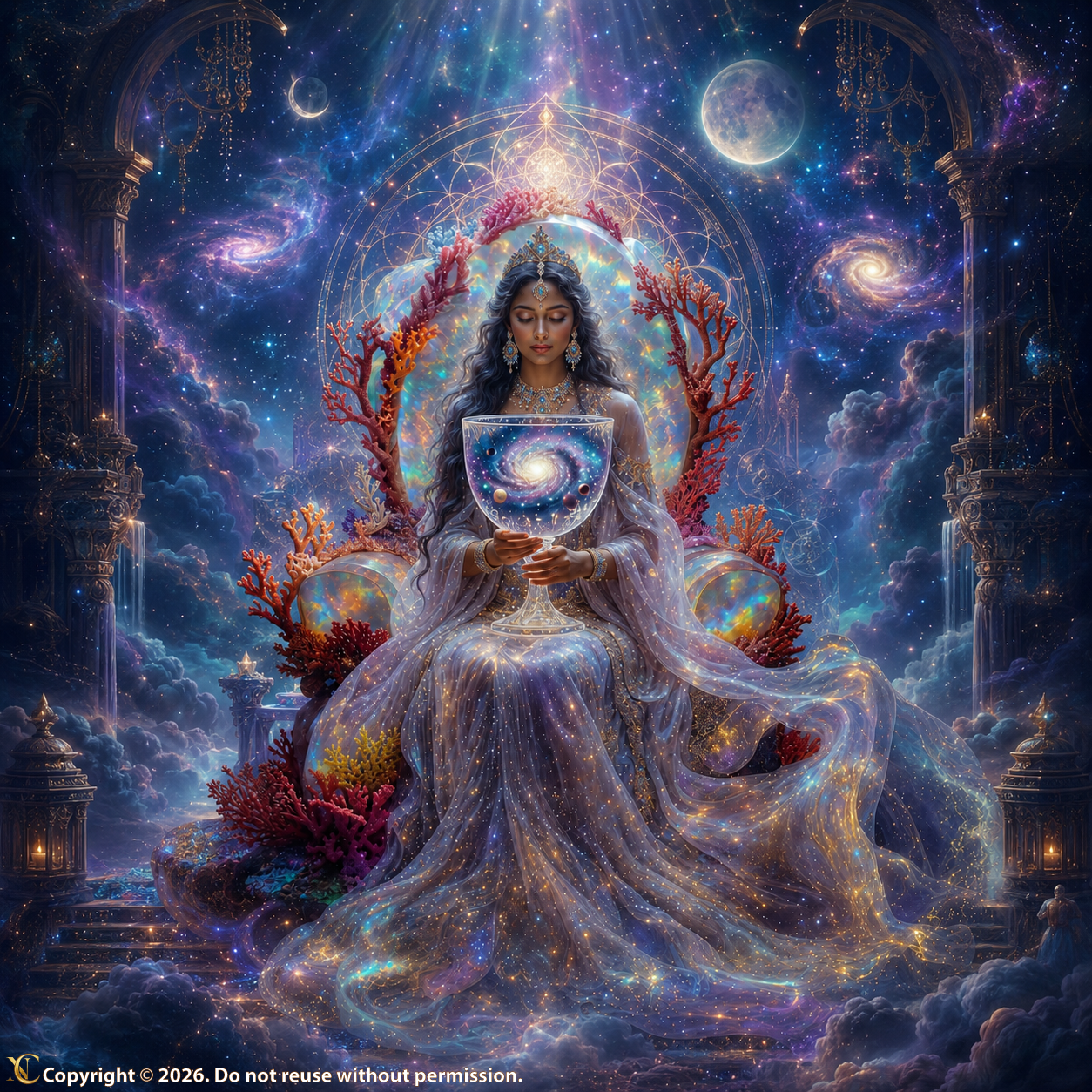
The Queen of Cups represents emotional depth, compassion, acceptance, and composure. Cups are the suit of emotion, and throughout Tarot we see them expressing love, grief, longing, joy, disappointment, connection, and healing.
The Queen of Cups has felt all of these emotions, yet she is not ruled by them.
Her strength lies in her ability to love deeply without allowing love to erase her identity. She is sensitive, but not fragile. She is compassionate, but not without boundaries. Her heart is open, yet she understands that emotional dignity matters.
I often think of the Indian woman who becomes the emotional centre of her family. She remembers everyone’s birthdays, understands the moods in the room, comforts children, checks on ageing parents, keeps relationships together, and somehow knows when someone she loves is struggling even before they say it.
That nurturing instinct is beautiful. But the Queen of Cups also carries an important reminder: the woman who gives love must also receive care.
Being emotionally generous does not mean accepting disrespect. Being understanding does not mean constantly sacrificing your peace. Self-care is not selfishness; it is the foundation that allows love to remain healthy.
When the Queen of Cups appears in a reading, I often see her as an invitation to ask: Am I honouring my feelings as much as I honour everyone else’s?
The mature Queen does not suppress her emotions. She understands them, honours them, and chooses how to respond with grace.
Queen of Pentacles: The Woman Who Creates Security and Knows What Is Valuable
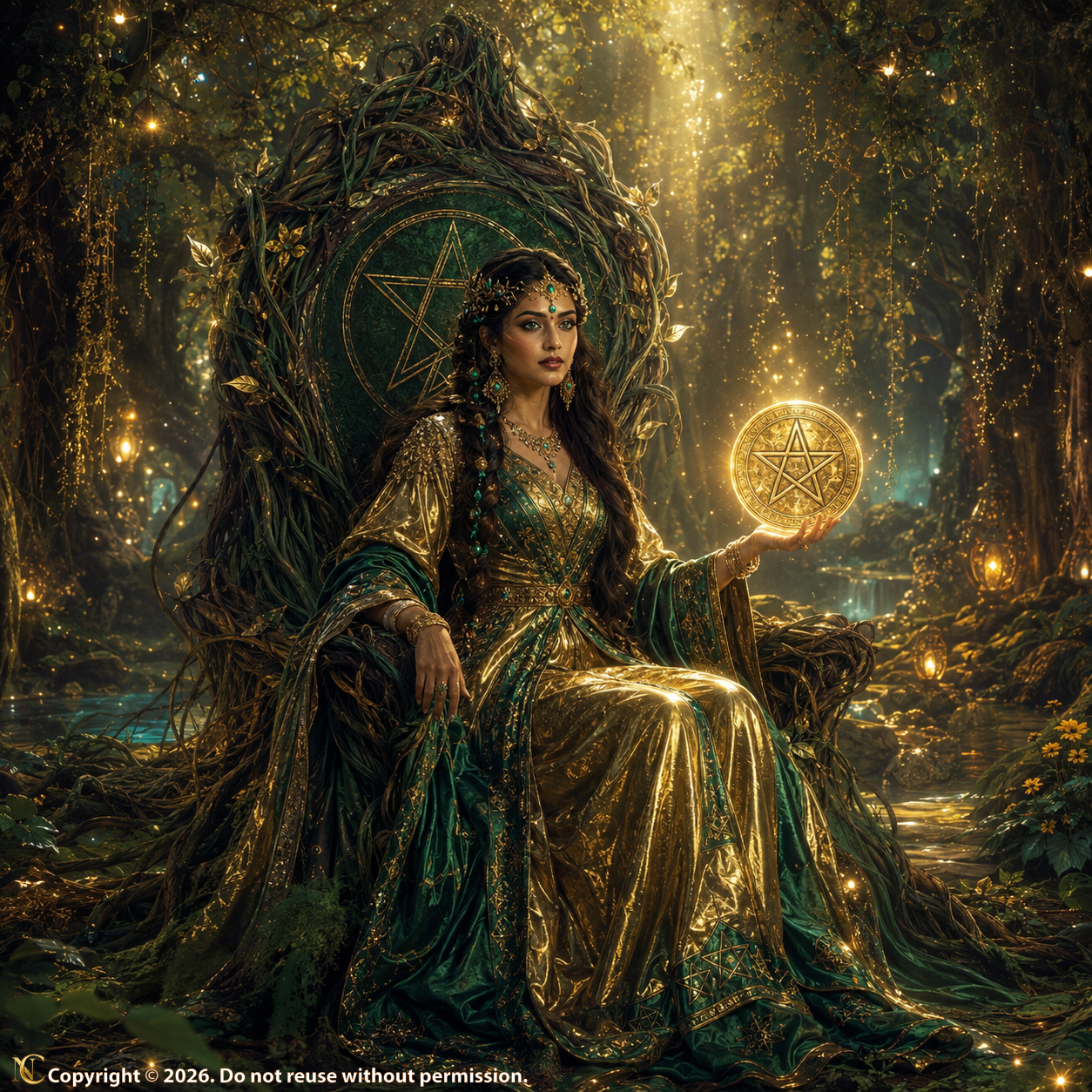
The Queen of Pentacles represents our emotional relationship with the material world—money, possessions, home, security, comfort, and the things we value.
She is practical without being cold. She understands that money is not merely currency; it can represent independence, responsibility, stability, and the freedom to care for ourselves and those we love.
For many Indian women, this energy feels immediately familiar.
Think about the woman who knows exactly how a household runs. She manages expenses, remembers investments, protects family jewellery, saves for the future, understands the sentimental value of an old sari, and somehow knows which things are worth preserving for the next generation.
There is wisdom in that.
The Queen of Pentacles knows the difference between value and accumulation.
Sometimes we hold on to objects because they carry memories. Sometimes we hold on because we fear scarcity. And sometimes we keep things simply because we have never stopped to ask whether we still need them.
This Queen gives us permission to examine both our physical and emotional clutter.
What deserves protection?
What deserves investment?
What carries genuine meaning?
And what have we been carrying simply because we are afraid to let it go?
The Queen of Pentacles is an even-handed manager. She respects wealth without worshipping it. She values comfort while recognising that possessions should support our lives, not control them.
For me, her message is beautifully simple: honour what is valuable, protect what is meaningful, and release what has become a burden.
Queen of Wands: The Woman Who Walks Into the Room Knowing Who She Is
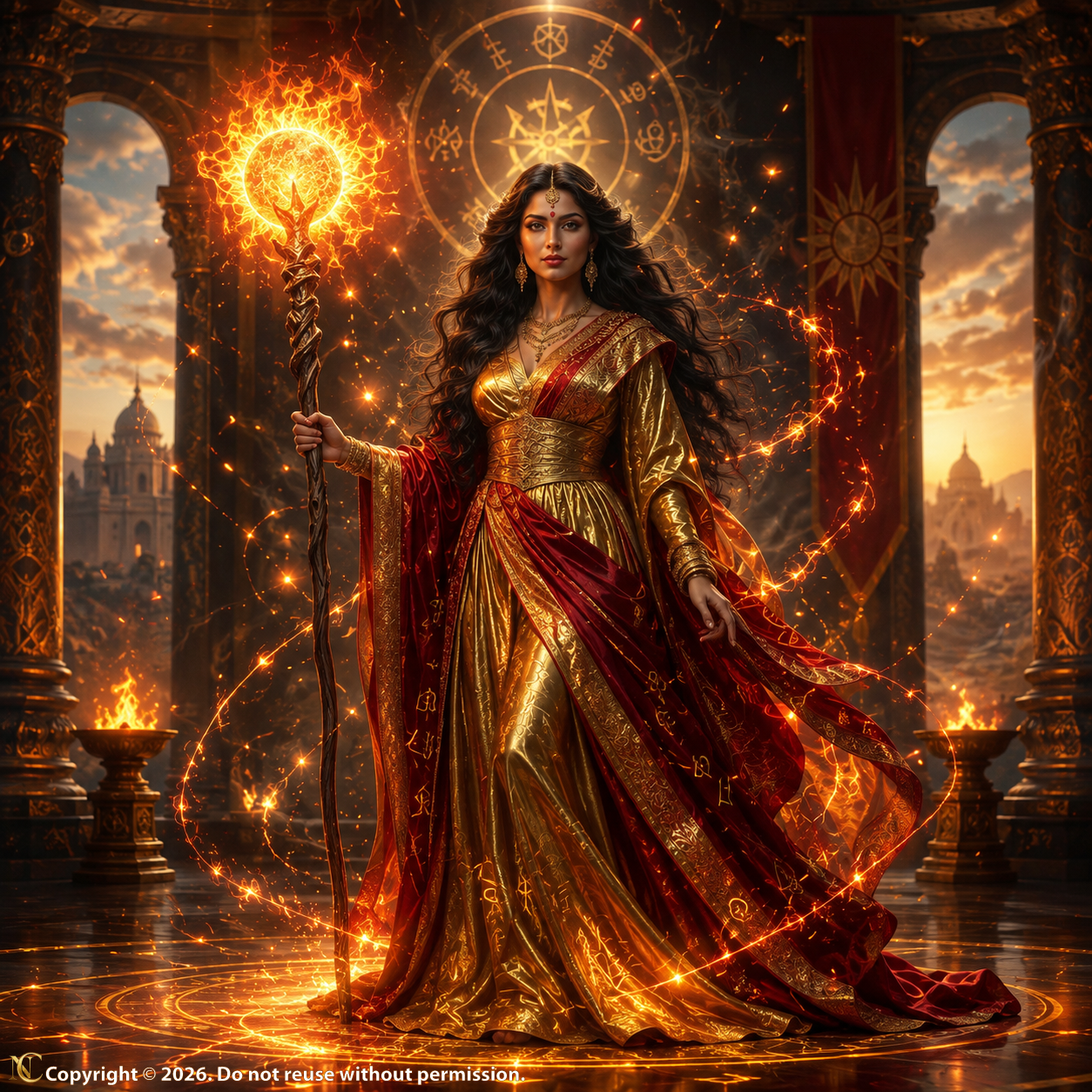
The Queen of Wands carries confidence, creativity, enthusiasm, and an instinctive ability to solve problems.
Wands represent energy, ambition, inspiration, and movement. Traditionally, a wand is a staff that supports us on a journey. In Tarot, that symbolism expands into the idea of creative action—the ability to find a way forward when life presents a challenge.
The Queen of Wands does not wait for somebody else to give her permission.
She knows what she brings to the table.
I see her in the Indian woman who walks into a room and naturally changes its energy. She may be an entrepreneur, artist, mother, leader, professional, student, or someone beginning a completely new chapter of life. What matters is not her title but the confidence with which she occupies her own space.
She is the woman who looks at an obstacle and asks, How do I solve this?
She takes bold leaps.
She starts businesses from spare bedrooms and kitchen tables. She changes careers when the old path no longer feels right. She creates opportunities where none seemed obvious. She makes something beautiful out of circumstances other people might have dismissed.
The Queen of Wands reminds us that confidence does not always arrive before action. Sometimes confidence is created because we acted despite uncertainty.
Her power is not arrogance. It is self-belief.
When she appears in a tarot reading India seekers may interpret her as a reminder to stop shrinking yourself to make other people comfortable. Your enthusiasm, creativity, ambition, and presence are not things that need to be apologised for.
Sometimes the next chapter of your life begins when you finally believe you are capable of writing it.
Queen of Swords: The Woman Who Knows the Power of Her Voice

The Queen of Swords represents clarity, communication, intelligence, honesty, and discernment.
Swords rule the world of thought, ideas, words, and decisions. Sword cards can sometimes indicate arguments, confusion, mental pressure, or difficult truths. Yet the Queen of Swords shows what happens when mental energy becomes mature and controlled.
She does not shout simply to be heard.
She speaks because she knows what needs to be said.
There is tremendous power in that.
For generations, women have often been taught to soften uncomfortable truths, maintain harmony at any cost, or remain silent because speaking clearly might be considered difficult, unfeminine, or disrespectful.
The Queen of Swords rejects that false choice.
A woman can be kind and clear.
She can be loving and still say no.
She can respect others while refusing to abandon her own truth.
I see this Queen in the woman who has learned through experience. She listens carefully, thinks clearly, and cuts through confusion with wisdom rather than drama.
Her sharpness is not cruelty. It is discernment.
When the Queen of Swords appears, I often ask: What truth already feels obvious to me, even if I have been avoiding saying it aloud?
Her message is to communicate with dignity, precision, and confidence. Words carry power, and a queen understands how to use that power responsibly.
The Queen in the Past, Present and Future Positions
Where a Queen appears in a Tarot spread can add another layer to her message. Although each Queen retains the essential qualities of her suit, her placement helps us understand how that energy may be influencing the question.
A Queen in the Past Position
When a Queen appears in the past, she often points toward a significant woman who helped shape your emotional foundation.
For many of us in India, this immediately brings to mind a mother, grandmother, aunt, teacher, elder sister, or another strong woman whose presence influenced the way we understand love, money, ambition, communication, or resilience.
Sometimes the Queen represents ancestral strength.
You may recognise qualities in yourself that you inherited not through possessions, but through example—the courage of a grandmother who rebuilt her life after hardship, the discipline of a mother who quietly held a family together, or the intelligence of a woman who taught you never to surrender your independence.
The Queen can also represent your own emotional strength from an earlier chapter.
Perhaps something you survived years ago created the foundation on which your current life now rests. A difficult period may have taught you boundaries, resilience, patience, financial independence, or the courage to trust your own judgement.
A Queen in the past asks us to honour the women—and the earlier versions of ourselves—who helped us become who we are today.
A Queen in the Present Position
When a Queen appears in the present, she suggests that you already possess a degree of emotional mastery over the situation you are asking about.
You may not have every answer yet, but your instincts deserve attention.
If the question concerns love, the Queen can indicate that your intuition about the emotional dynamics around you is worth trusting. Instead of endlessly seeking validation from outside, there may already be a quiet knowing within you.
The same applies to practical matters.
You might be navigating a property decision, business negotiation, financial conversation, professional opportunity, or difficult relationship dynamic. Obstacles can still exist, but the Queen in the present suggests that your inner response to the situation is becoming clearer.
This is where the four Queens offer different kinds of wisdom.
The Queen of Cups asks you to trust emotional intelligence.
The Queen of Pentacles asks you to trust practical judgement.
The Queen of Wands asks you to trust confidence and creative instinct.
The Queen of Swords asks you to trust clarity and reason.
In each case, the message is similar: do not underestimate the wisdom you have already developed.
A Queen in the Future Position
There is something beautifully reassuring about seeing a Queen waiting in the future.
Fairy tales may tell us, “and they lived happily ever after,” but real life teaches us that happiness is rarely a perfect ending handed to us by destiny.
It is something we build through self-trust.
A Queen in the future suggests that the path ahead can bring greater emotional maturity, confidence, stability, or clarity. The choices you make now can lead toward a version of yourself who feels more grounded in her own authority.
Your intuition may become clearer.
Your boundaries may become stronger.
Your decisions may become less dependent on approval from others.
That, to me, is the deeper Tarot version of happily ever after—not a life without challenges, but a woman who knows she can meet those challenges without abandoning herself.
Every Indian Woman Already Carries a Queen Within Her
When I look at the four Queen tarot cards together, I do not see four separate women.
I see four dimensions of the same powerful woman.
She is the Queen of Cups when she loves deeply and honours her emotions.
She is the Queen of Pentacles when she builds security, protects what matters, and manages the realities of life with wisdom.
She is the Queen of Wands when she enters the world boldly, creates opportunities, and refuses to dim her fire.
And she is the Queen of Swords when she speaks clearly, chooses truth, and trusts the intelligence she has earned through experience.
Indian woman power has never existed in only one form.
Sometimes it looks like Rani Lakshmibai riding into history with extraordinary courage. Sometimes it carries the fierce protective symbolism we associate with Goddess Durga. And sometimes it looks like the woman sitting quietly at the centre of an ordinary Indian home, making a hundred decisions every day that nobody else even notices.
That woman is no less powerful.
For me, Tarot does not give a woman her crown.
It reminds her that she was already wearing one.
If one of the Tarot Queens has been appearing in your life—or you simply feel ready to understand your own journey more deeply—I invite you to explore a personal reading with us at TarotReading.in.
Sometimes the cards do not tell us who we should become.
Sometimes they simply help us recognise the queen we already are.
With love and light,
Nikita Chaturvedi
Founder, TarotReading.in