
What Is the Esoteric Divination Board?
Understand its purpose, structure and symbols—and how Tarot, Hermetic Qabalah, astrology, the four elements and sacred geometry meet in one visual map.
✦ A Visual Map of Symbolic Relationships
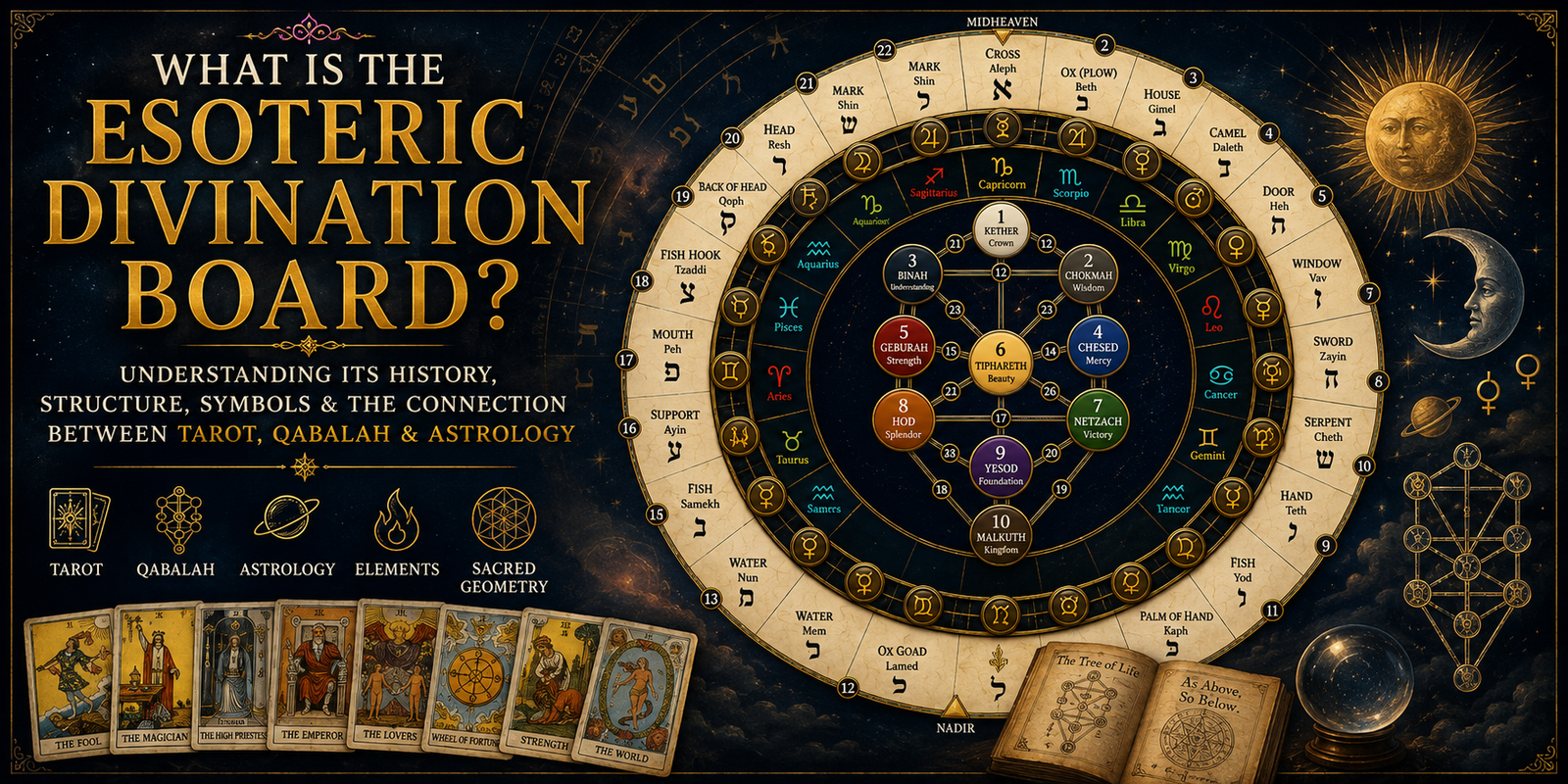
The Esoteric Divination Board is a modern study and reading framework that places several Western esoteric correspondence systems in a single visual field. Its aim is not to flatten those traditions into one doctrine, but to make their selected relationships easier to see.
A beginner can use it to discover the deeper symbolic layers around Tarot. A more experienced reader can use it to compare archetypes, paths, elements and astrological qualities—provided the attribution system is named clearly.
✦ The Essential Answer
| What it is | A modern TarotReading.in framework for organising selected Tarot, Hermetic Qabalah, astrology, elemental and geometric correspondences. |
|---|---|
| What it does | Helps readers study, compare, meditate on and—within a defined method—interpret connected symbols. |
| Central structure | A Tree of Life surrounded by rings or fields of linked symbolic information. |
| Core principle | Correspondence: one archetype can be explored through several symbolic languages. |
| What it is not | It is not one unchanged ancient artifact, a universal map accepted by every tradition or a guarantee of future events. |
| Best beginner route | Start with Tarot and the four elements; add the Tree of Life, Hebrew-letter attributions and astrology gradually. |
✦ What Does “Esoteric” Mean?
Here, esoteric means looking beneath a symbol’s most familiar reading to study its deeper philosophical, spiritual and structural associations. It does not mean that knowledge must be secret or reserved for an elite.
✦ What the Board Is Designed to Do
Correspondence: One Symbol, Several Languages
A correspondence is a relationship assigned between symbols in different systems. In the Golden Dawn-derived sequence used by many modern Hermetic readers, The Magician can be followed through this chain:
Reader tip: a correspondence is not proof that two traditions are historically identical. It is a chosen interpretive bridge. Always identify the deck or school whose bridge you are using.
✦ The Tree of Life and Ten Sephirot
The centre of the board uses a Tree of Life: ten connected spheres called sefirot in Jewish Kabbalah and commonly transliterated Sephiroth in older Western occult writing. On this board they function as an organising structure for states, forces and relationships. Their short keywords below are study prompts, not exhaustive definitions of Jewish theology.
Crown
Source, unity and the highest point of the diagram
Wisdom
Dynamic force, expansion and creative impulse
Understanding
Form, structure and receptive intelligence
Mercy
Order, generosity and constructive expansion
Severity
Discipline, boundaries and corrective strength
Beauty
Balance, integration and solar consciousness
Victory
Desire, feeling and creative expression
Splendour
Language, analysis and patterned thought
Foundation
Dream, image and the mediating subconscious
Kingdom
Embodiment, matter and lived experience
✦ The Twenty-Twofold Correspondence
Later Hermetic Qabalistic systems connect the 22 paths on a particular Tree of Life diagram with the 22 Hebrew letters and the 22 Major Arcana. This creates a compact study structure, but details vary among occult schools.
| Hebrew letter | Name | Golden Dawn-derived Tarot attribution | Study lens |
|---|---|---|---|
| א | Aleph | The Fool | Openness, breath, beginning |
| ב | Beth | The Magician | Mind, language, mediation |
| ג | Gimel | The High Priestess | Threshold, receptivity, mystery |
| ד | Daleth | The Empress | Doorway, fertility, relationship |
| ה | Heh | The Emperor | Vision, authority, articulation |
| ו | Vav | The Hierophant | Connection, teaching, tradition |
✦ Astrology, the Four Elements and the Minor Arcana
Astrology contributes a celestial vocabulary. Traditional Hermetic systems begin with the seven classical planets—Sun, Moon, Mercury, Venus, Mars, Jupiter and Saturn—plus the twelve zodiac signs. Modern astrologers may add Uranus, Neptune and Pluto; those additions should be labelled as modern rather than silently folded into an older scheme.
Fire · Wands
Will, action, passion, creativity and transformation.
Water · Cups
Emotion, intuition, relationship, sensitivity and imagination.
Air · Swords
Thought, speech, reason, decision and perception.
Earth · Pentacles
Body, work, resources, stability and material experience.
These suit-element pairings are common in modern Western Tarot, but alternative decks may organise their suits differently. Let the deck’s own guidebook and imagery lead.
Why the Board Uses Concentric Circles
A circular plan turns a list into a field of relationships. It lets the eye move from a centre through linked bands of information and back again, while visually echoing cycles, unity, time and wholeness.
Tree of Life
The structural map: spheres, paths and the relationships between them.
Letters, Cards & Sky
Hebrew-letter names, Major Arcana, planets, zodiac signs, numbers and elements can occupy adjoining layers.
Positions & Tokens
Directions, reading zones or physical markers can be added when their roles are defined by the board’s method.
Method note: tokens do not carry one universal occult meaning. Their exact role—planet, element, position, timing or influence—belongs to the documented TarotReading.in methodology for a given reading.
✦ Follow a Symbolic Pathway
The board is not a geographical map. It is a map of interpretive relationships. Start with the symbol you actually selected, move through only the relevant layers and finish with a clear reflection.
The same movement can be applied to every Major Arcana card. The wider “Fool’s Journey” then becomes a sequence of encounters—with creation, intuition, authority, love, choice, change, justice, surrender, transformation, hope, illumination and completion.
✦ Is the Esoteric Divination Board Ancient?
No—the specific board presented by TarotReading.in should be understood as a modern synthesis unless documentary evidence establishes otherwise. Its ingredients do have long and complex histories, but they did not begin as one unified object.

Explore the Symbols with Nikita
A correspondence map becomes most useful when it returns you to the question you are living. If you would like a personal reading, Nikita can help translate Tarot’s symbolic layers into a grounded conversation about your present choices.
✦ How to Study the Board Without Overwhelm
Learn one layer well enough to recognise it before adding the next. Open any step for the practical focus.
01FoundationLearn the 78 Tarot cards
Begin with visual vocabulary, suit structure and recurring themes.
02ArchetypesStudy the 22 Major Arcana
Track each trump as an archetype before adding correspondence systems.
03StructureMeet the ten Sephirot
Learn the names, positions and broad functions on the Tree of Life.
04MovementExplore the 22 paths
Treat paths as relationships or transitions within a chosen Hermetic diagram.
05LanguageLearn the Hebrew letters
Study their names and forms respectfully; avoid treating simplified glosses as complete meanings.
06SkyAdd astrology
Start with the seven classical planets and twelve zodiac signs, then note modern additions separately.
07TextureWork with four elements
Use Fire, Water, Air and Earth to describe how a theme expresses itself.
08ContextRead Hermetic history
Distinguish Jewish Kabbalah, Christian Cabala and later Hermetic Qabalah.
09MethodLearn the board rules
Document what every ring, position and token means in the TarotReading.in method.
10SynthesisPractise layered readings
Combine only the layers that clarify the question, then translate insight into grounded action.
✦ What Can You Ask the Board?
Prefer open, reflective questions over demands for certainty. They make space for pattern recognition while keeping decisions with the person asking.
✦ Before You Interpret a Result
✦ Esoteric Divination Board FAQ
What is the Esoteric Divination Board?
It is TarotReading.in’s modern visual framework for studying and combining Tarot, Hermetic Qabalah, the Tree of Life, Hebrew-letter attributions, astrology, the four elements and related symbolic correspondences.
Is it the same thing as Tarot?
No. Tarot is one major layer of the board. The board places Tarot beside other symbolic systems so their relationships can be explored.
Is the board an ancient historical artifact?
No documented evidence establishes this specific combined board as an ancient object. It is best described as a modern synthesis inspired by older traditions whose histories are different from one another.
Are Jewish Kabbalah and Hermetic Qabalah interchangeable?
No. Hermetic Qabalah is a later Western esoteric synthesis influenced by Jewish Kabbalah and also shaped by Christian Cabala, ceremonial magic, astrology and Tarot. This article uses “Qabalah” when discussing that Hermetic layer.
Do all Tarot traditions use the same path and letter correspondences?
No. Attributions can vary by school, deck and author. Strength and Justice numbering is a familiar example. Name the system you are using before interpreting the table.
Can a beginner use the board?
Yes. Begin with Tarot and the four elements, then add the Tree of Life, Hebrew letters and astrology gradually. You do not need to activate every layer in every reading.
Does the board predict the future?
It may be used in divination, but it cannot guarantee outcomes. Use it to organise reflection, recognise patterns and consider choices while keeping responsibility with the reader.
✦ Build the Correspondences on Solid Ground
- The Metropolitan Museum of Art — “Before Fortune-Telling: The History and Structure of Tarot Cards”, for the fifteenth-century history and original game structure of Tarot.
- My Jewish Learning — “What Are the Sefirot?”, for an accessible introduction to the ten sefirot in Jewish Kabbalistic theology.
- Journal of the Western Mystery Tradition — “The Kabbalistic Tree of Life”, for a comparison of Hermetic and traditional Hebrew Tree models and Golden Dawn colour/path material.
- J. H. Chajes, The Kabbalistic Tree, for the history of visual Kabbalistic diagrams.
- Israel Regardie, The Golden Dawn, for the influential Hermetic correspondence system used in many modern Tarot traditions.
The Board in One Sentence
The Esoteric Divination Board is a modern visual map that helps a reader explore selected relationships among Tarot, Hermetic Qabalah, astrology and the elements—while keeping each source tradition historically distinct.
Continue Your Esoteric Tarot Journey
Explore the board one symbolic layer at a time, then return to the cards with a clearer eye for relationship, pattern and context.